The Wonder of Math
DID YOU KNOW?
State Standards are the most important guideposts for K-12 math instruction in America's schools. State standards describe what should be taught in public schools, although they usually leave school districts and individual teachers significant leeway in how to teach. They also provide private schools, charter schools, and home schools with a set of guidelines to promote quality math education for all students.
The Problem:
The Need for New k-12 Math Standards


Of US states are based on or heavily influenced by a single low content model standards called common core state standards (CCSS)

Nationally, 73% of 8th grade students fall below the targeted math proficiency level

All states have 37% or less of 8th grade math students meeting target
America's most used math standards, the Common Core State Standards, (CCSS), fail students. The Common Core State Standards for Mathematics (CCSSM) have failed to raise achievement or ensure equitable math education. Vague and overly reliant on ineffective inquiry-based methods, these standards have coincided with declining student performance on NAEP and PISA tests, particularly among struggling learners. Fewer students are prepared for college-level math, and universities now rely heavily on international students in advanced STEM fields. Meanwhile, frustrated teachers cite the confusing and impractical standards as a reason for leaving the profession. Despite high education spending, U.S. math outcomes remain poor. A shift to clear, content-rich, and evidence-based standards - like the Archimedes Math Standards - is urgently needed.
The Roadmap to restore math literacy
Clear Standards with content

Better professional development

Content Experts
Better student learning


2nd Grade Example:
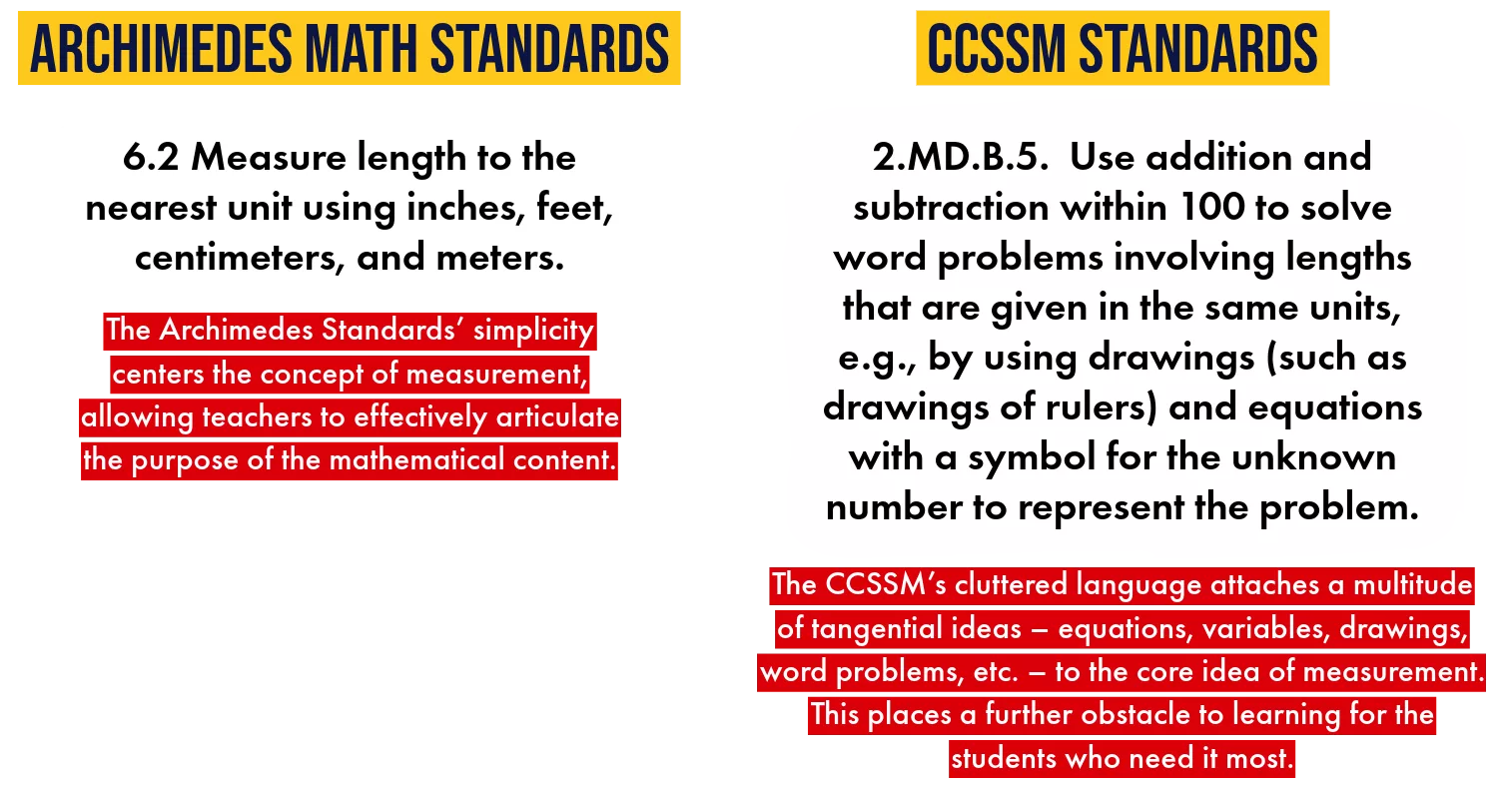
A comparison of CCSSM'S verbose standards with the Archimedes Standards' equivalent for second grade
Why the name?
We named our standards The Archimedes Math Standards to reflect the spirit of one of history's greatest mathematicians-who embodied both the beauty and the utility of math. He was deeply committed to mathematical discovery, deriving an early approximation of it and developing methods that would later influence calculus. Yet he also applied these abstract principles to practical challenges, designing machines like the Archimedes' screw and creating ingenious defensive systems for his city of Syracuse. He understood that mathematics was both a worthy subject of contemplation and a powerful tool for solving real-world problems.

Take Action!
The standards, framework and lesson plans are all complimentary.
For parents, teachers, community members and state officials