By: Sabrina Caserta
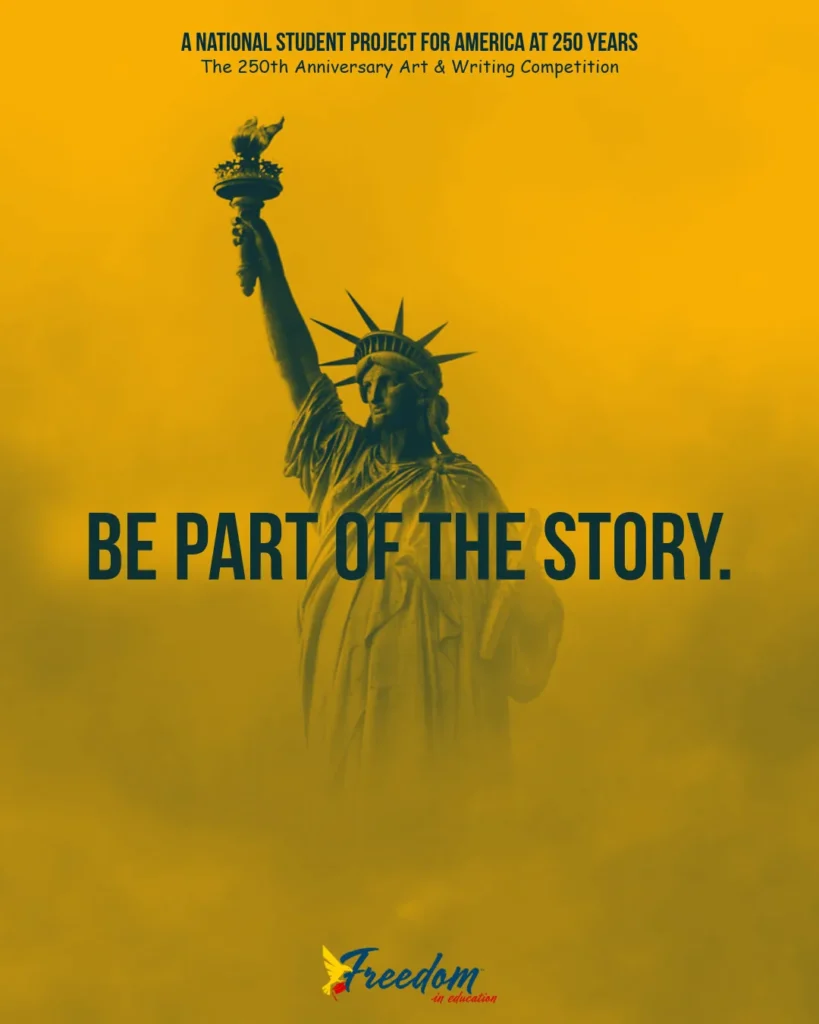
Earlier this year, we asked students across America a simple question:
What does freedom mean to you?
The answers arrived in crayon and pencil, in careful handwriting and hurried sketches.
Some drew American flags. Some drew footballs and fireworks. One talked about the freedom to eat ice cream for breakfast. Another described freedom as breaking out of the cage of their own mind.
Some spoke about family. Some spoke about faith. Some spoke about opportunity. Some spoke about having a voice. But no two answers were exactly alike.
And perhaps that itself is part of the answer.
For 250 years, Americans have debated almost everything. We have argued about laws and leaders, policies and priorities, traditions and change. We have disagreed loudly, passionately, and often imperfectly. Yet beneath those disagreements lies something enduring: a country where millions of people are still free to arrive at different conclusions about what matters most.
Freedom, it seems, was never meant to produce uniformity.
Freedom creates possibility. It creates space for conviction, for conscience, for curiosity. Space to ask questions that do not always have easy answers. Space to become.
That is part of why education matters. Not because it exists to produce agreement, and not because it exists to shape a single worldview, but because freedom depends on people who can think.
A free society depends on its people being able to read deeply, reason clearly, communicate honestly, and distinguish truth from noise.
Freedom is not sustained by slogans. It is sustained by understanding.
Every generation inherits liberty. Every generation also learns, in its own way, how to keep it.
That work often begins in classrooms.
Long before students cast ballots, they learn how to weigh evidence. Long before they lead institutions, they learn how to solve problems. Long before they enter public debates, they learn how to listen, question, and think.
At its core, education may be less about politics than about what it means to be human.
To unlock the potential of a mind. To give a child access to knowledge. To help them understand the world they have inherited and prepare them to shape the world they will leave behind.
This is part of why the science of learning matters.
Not because it belongs to any one group or advances any one ideology, but because children matter.
The way humans learn does not change with political winds. A child’s brain is not shaped by our tribal allegiances. A struggling reader does not benefit from the weight of our cultural battles.
Children deserve learning environments where their needs remain at the center of the conversation.
Too often, public discourse can confuse volume with wisdom.
Outrage can begin to feel like certainty. Disagreement can start to feel like danger.
But freedom asks something steadier of us.
It asks us to be willing to hear perspectives we do not immediately share. To defend our own ideas without needing to silence others. To recognize that disagreement is not necessarily a threat to democracy—it can also be evidence of it.
Civil discourse is not a weakness of a free people. It is one of their strengths.
The goal is not that we all think the same. The goal is to build a society where people can think differently without losing sight of each other’s humanity.
That lesson may be one of the most important gifts we pass to the next generation.
As we reflect on 250 years of American freedom, we return to the voices of students who answered our question—each in their own way, shaped by different experiences and different hopes.
And yet many point toward a shared idea: freedom is not only the absence of restraint, but the presence of possibility.
The possibility to learn. To question. To grow. To contribute. To speak. To listen. To believe. To build. To become.
The work before us is not only about preserving freedom for another generation.
It is about ensuring that every child has the opportunity and preparation to exercise it.
Because the future of a free society will not be determined by the loudest voices in the room, but by whether we have equipped the next generation to think, to learn, and to lead.
That is the work before us.
That is the promise of education.
And that is the responsibility of freedom.