By: Amos Tarfa
Let’s think about two scenarios.
Scenario 1: The teacher walks into the class, writes down a few problems on the board, and starts explaining the concept. They do not explain the applications. They don’t tell the students where the concept came from. All they’re told is, “Here is the material you need to know because you need this to pass the class in order to go to the next class.”
Scenario 2: The teacher walks into the class and tells the students, “Imagine you’re living in England in the 1660s. You’re trying to understand the motion of planets and why objects fall. During the plague, Isaac Newton had time to work independently and developed ideas that became foundational to calculus. Calculus would help us understand more about astronomy, nature, and reality.”
Now the teacher proceeds to teach the principles and concepts within calculus in light of how calculus originated and what it was developed to help us understand.
Which scenario would you prefer to be involved with?
I would prefer scenario two.
Teaching concepts without context could become an even bigger problem in the era of artificial intelligence. Students can look at a math problem and say, “I can figure this out. I have a computer that can help me do this.”
So how do we get students to care enough to want to understand the mathematics themselves? How do we get them to want to work hard at something when a machine can produce an answer in seconds?
Telling the story of mathematics may be part of the answer.
Mathematics Has a Story
Mathematics isn’t simply a collection of rules and formulas from a textbook. It is a body of knowledge that human beings have developed, questioned, explored, and expanded over thousands of years.
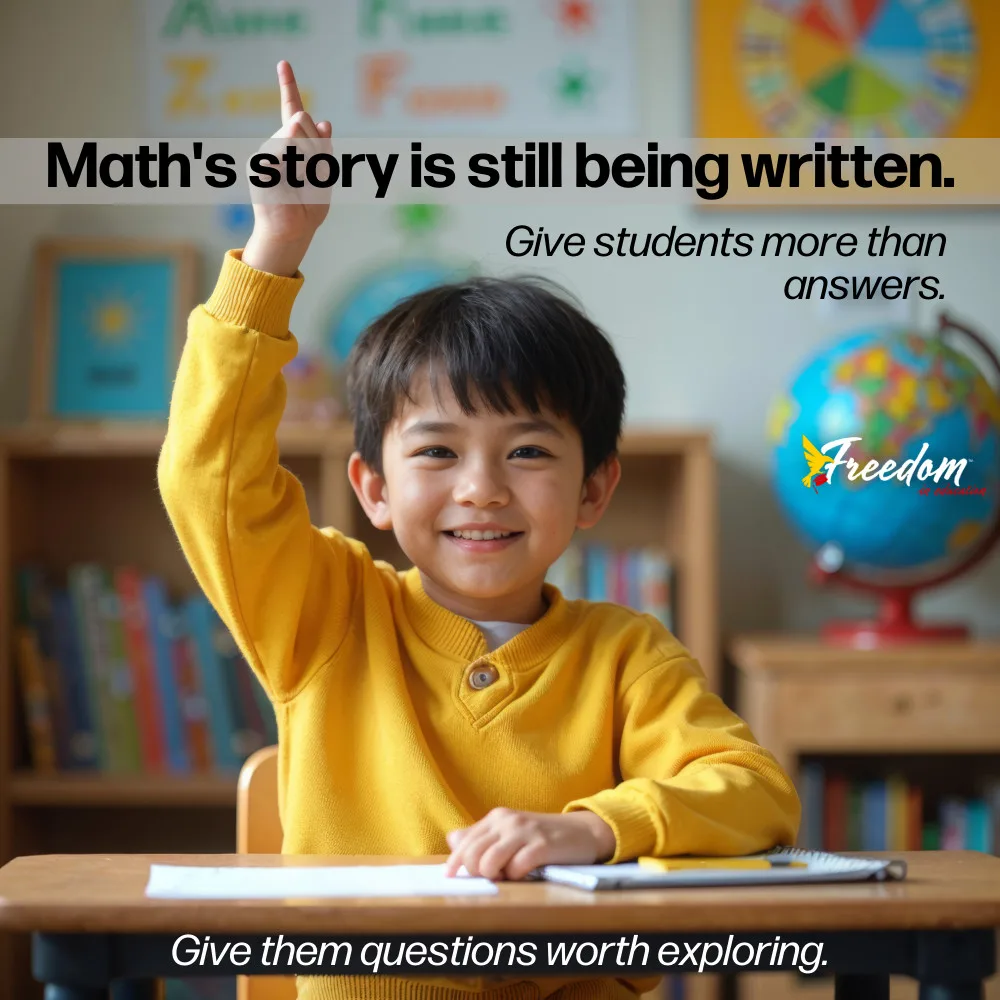
The story of mathematics is still being written.
Every topic in mathematics came about within a certain context. Some mathematical ideas were developed to solve practical problems, while others emerged from a desire to understand patterns, relationships, and the world around us.
When students understand the context that gave rise to a mathematical concept, they can begin to see mathematics differently. They can understand that the ideas they are learning were not simply placed in a textbook. They were developed by real people trying to answer real questions.
And they can begin to see that they, too, can take part in that story.
A Problem That Inspired a Child
There is a famous story about Andrew Wiles, who encountered Fermat’s Last Theorem as a 10-year-old boy. He became fascinated by the problem and decided that he wanted to solve it.
Decades later, after earning his PhD in mathematics and becoming a professor at Princeton, Wiles devoted years to proving Fermat’s Last Theorem. He ultimately announced a proof in 1993, with a corrected proof completed in 1994.
Why is this important?
Because as a child, Wiles saw a mathematical problem and did not think, “This is impossible. I can’t be part of this.”
He saw an opportunity.
Every child needs to be inspired to understand that they can take part in the history of mathematics.
What will your children discover? What problems will they learn to solve? What strategies will they develop that they can eventually teach to someone else?
Mathematics is not all about formulas, as many students experience it in school. It is about questions, ideas, discoveries, and the people who pursued them.
Mathematics and the Search for Understanding
It is interesting to note that the history of astronomy is deeply connected to the history of mathematics.
Think of Copernicus, Kepler, Galileo, and Newton. Questions about the movement of planets and the nature of the universe helped inspire major developments in mathematics.
Newton’s work is one example. During the plague closures in England in the 1660s, Newton made major advances in mathematics and developed important ideas that became part of calculus as he worked to understand problems involving motion and the natural world.
Leibniz independently developed calculus as well, and his story is another important part of the history of mathematics.
These stories show students that mathematics does not exist in isolation. Mathematical ideas have been developed in connection with science, astronomy, engineering, and humanity’s desire to understand the world.
And that story is not finished.
Today, in 2026, there are mathematical problems that we have not solved yet. There are questions we have not answered and problems that may require new ways of thinking.
Understanding mathematics can help students develop the knowledge and problem-solving abilities they need to engage with those questions.
The goal should not simply be for students to learn what mathematicians discovered in the past.
We should help them understand that the story of mathematics is still being written—and they can be part of it.
About Amos:

Amos Tarfa is a Medical Physicist and Math and science curriculum writer who is seeking to help every child reach their full potential in mathematics and in life. His goal is to raise the next generation of top mathematicians, scientists and thinkers who also know the history and philosophy of science, logic and theology. He has written a curriculum called Counting To Calculus which can take anyone from basic mathematics to calculus in 1 year. Amos is married to Stephanie and they have 7 children. They live in Cheyenne Wyoming. He teaches a summer MIT Outreach Math Class in Wyoming.
Relevant Links